
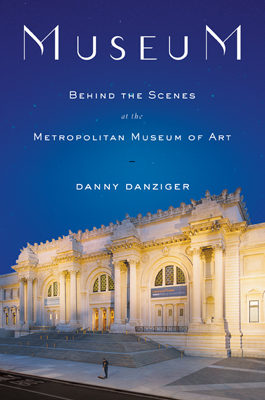
One of the books I'm reading right now, Museum: Behind the Scenes at the Metropolitan Museum of Art (Danny Danziger, 2007), consists of short interview-style essays that offer different perspectives on the museum from the people that work there. In alphabetical order, everyone from curators and board members to the head of security and the guy who's been in charge of the information desk for 30 years is represented. Since the Met is both the most popular tourist destination in New York City and the 2nd largest art museum in the world (beat only by the Louvre), I thought it would be a good place to get a sense of what the people who work there think it's for and how they witness the dynamic between their institution and the people that flock to see it. I've been transcribing notes from the book as I go along and I'm only about a third of the way through, so I'll just deal with a few at a time. These first opinions all happen to be from people that have a bit more to do with directing the larger decisions that are made at the museum, but I was struck by how many of them sounded in turn both bitter and wistful about the situation.
I've frequently witnessed the dazed look that overcomes visitors the moment they step into an art museum lobby, suddenly faced with the daunting task of spending a few hours looking at hundreds of objects not only with no particular area of interest or goal in mind, but also in no particular order. This proposition, all in between the scenic strolls, binge shopping and dinners at crowded theme restaurants, is understandably overwhelming, but I'm still not convinced that the art museum experience should be dismissed as an "extension of tourism: places for people to go, often simply to say they have been there, ticked it off the list," as Keith Christiansen (Jayne Wrightsman Curator, European Paintings) claims. I have, however, certainly observed what Christiansen later says about the attention span of many visitors: "on any given day you'll find any number of people who would rather be someplace else and, quite frankly, they probably shouldn't have bothered to come". The people who go through the museum with a scowl on their faces acting rudely to the staff. The kids who invariably cry for ice cream as the parents consider purchasing a museum membership. The people answering their cell phones in the gallery. You know who.
There is a certain shift in the economics of cultural institutions that Laurence B. Kanter (Curator in Charge, Robert Lehman Collection) relates directly much, much better than I could ever paraphrase at 1 am:
"When I first started going to the Cleveland Museum of Art as a child, I never felt like a privileged guest. The museum was very wealthy and well endowed, and it didn't care if anyone ever came into it or not. No museum survives that way today. Museums today don't do anything without having half an eye seriously glued to the bottom line. What works on the bottom line is entertainment, and so we compete with movie theaters and sports complexes for our audiences. Therefore museums become palaces of entertainment, because, frankly, entertainment will pay the bills. That is fine as far as I am concerned. I will do whatever it takes to keep the machinery going, to make sure the next generation has a chance to enjoy what I have enjoyed. It's very rewarding to see a lot of people looking at things. But I do resent seeing thousands of people crammed together to look at someone because he's on some bestseller type list of artists."
Even though his tone comes off as pretty pompous, I have to agree with some of the sentiments expressed by George R. Goldner (Drue Heinz Chairman, Drawings and Prints). He feels that the museum's job is to "instruct people on what they should look at, rather than simply say, 'OK, most people want to see van Gogh, so let's plaster the building with van Goghs' because when museums were first founded, they had "an explicit obligation to instruct and elevate people" rather than to "get more people in the building just because you had given them what they wanted... We should challenge people to look at new things, things the aren't used to looking at. I think one of the great failures of museums today is that we sell what people will buy, rather than try to teach people to want to buy something else."
Harold Holzer (Senior Vice President for External Affairs) has a more expansive expectation of how museum visitors should interact with what they see. "I love walking through the galleries looking at people looking at art, whether they're acting silly, posing in front of a sculpture, or taking a picture of a painting that's not going to come out right. Just see their eyes aglow," he says. Rather than serving as an escape from what Holzer calls "the hurly-burly of the present and to be absolutely transported by visions of beauty or reverence on a scale we don't experience anymore," Morrison Heckscher (Lawrence A. Fleischman Chairman of the American Wing) likens the museum's role of preserving artworks to that of a physician's dealings with matters of life and death. Referring to the British Museum, the V & A, the National Gallery, the Met, the Museum of Fine Arts in Boston, and the Philadelphia Museum of Art, Heckscher tells of how "We've gathered, and continue to gather, all the best things together, and we have an incredible duty and obligation to preserve everything for future generations".
These sweeping grand statements are all noble and good, but what about the fact that most people go through museums snapping pictures with their cell phones until they get bored of that and leave? What is being exchanged through their going to the museum (other than the cost of an admission)? Does the museum (as a composite entity) care what the visitor gets out of the experience? Tourism is both the practice of traveling for pleasure or recreation, as well as the business of catering to the needs of this activity, so tabling for a moment the many political implications and imbalances of power between 'the ones being catered to' and 'the ones doing the catering' in terms of social structure on a global scale, the tourists and their destinations (of which the Met must of course be counted) could conceivably contribute equally to the total tourist experience. Is the museum visitor required to have a serious approach to interacting with the work in order to understand it in a 'satisfactory' way? Anyway, if the business of tourism is founded on the practice of it, shouldn't the museum (as a sort of cultural business) be helping to shape the practice by the things that it offers on the menu? If going to the Met is really just something to check off the list while visiting NY, would the people stop coming without the regular van Gogh shows?
And now, some more pictures of people looking at art, which I always get a kick out of (Don't they seem confused even from the back?):


GOOD NIGHT!


No comments:
Post a Comment