$10 a pop, 3 for $25, or better yet, all 6 (collect them all!) for $50. Pretty clever, guys. I guess it IS technically a gesture of 'public ownership'. It's kind of like suckering local businesses to clean up the trash on the side of the highway in exchange for a small metal sign certifying adoption of that particular stretch of road. But wait, here's the best part: "Dots can also be purchased in person at the museum if you want to be sure to have your dots in hand for stocking stuffers!" HA!
Wednesday, December 23, 2009
Seurat = Super Stocking Stuffer?!
Though I'm not a member there anymore, I still get the Art Institute of Chicago's e-newsletter, and the other day I received the strangest appeal as part of their holiday fund-raising. 'Adopt a Dot from Seurat's "La Grande Jatte"', it says, "When you adopt a dot, you will receive a commemorative button pin in one of six colors chosen from the painting as well as a card describing the location of your dot."
$10 a pop, 3 for $25, or better yet, all 6 (collect them all!) for $50. Pretty clever, guys. I guess it IS technically a gesture of 'public ownership'. It's kind of like suckering local businesses to clean up the trash on the side of the highway in exchange for a small metal sign certifying adoption of that particular stretch of road. But wait, here's the best part: "Dots can also be purchased in person at the museum if you want to be sure to have your dots in hand for stocking stuffers!" HA!

$10 a pop, 3 for $25, or better yet, all 6 (collect them all!) for $50. Pretty clever, guys. I guess it IS technically a gesture of 'public ownership'. It's kind of like suckering local businesses to clean up the trash on the side of the highway in exchange for a small metal sign certifying adoption of that particular stretch of road. But wait, here's the best part: "Dots can also be purchased in person at the museum if you want to be sure to have your dots in hand for stocking stuffers!" HA!

Wednesday, December 9, 2009
The hurly-burly of the present

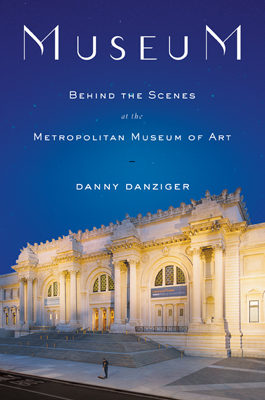
One of the books I'm reading right now, Museum: Behind the Scenes at the Metropolitan Museum of Art (Danny Danziger, 2007), consists of short interview-style essays that offer different perspectives on the museum from the people that work there. In alphabetical order, everyone from curators and board members to the head of security and the guy who's been in charge of the information desk for 30 years is represented. Since the Met is both the most popular tourist destination in New York City and the 2nd largest art museum in the world (beat only by the Louvre), I thought it would be a good place to get a sense of what the people who work there think it's for and how they witness the dynamic between their institution and the people that flock to see it. I've been transcribing notes from the book as I go along and I'm only about a third of the way through, so I'll just deal with a few at a time. These first opinions all happen to be from people that have a bit more to do with directing the larger decisions that are made at the museum, but I was struck by how many of them sounded in turn both bitter and wistful about the situation.
I've frequently witnessed the dazed look that overcomes visitors the moment they step into an art museum lobby, suddenly faced with the daunting task of spending a few hours looking at hundreds of objects not only with no particular area of interest or goal in mind, but also in no particular order. This proposition, all in between the scenic strolls, binge shopping and dinners at crowded theme restaurants, is understandably overwhelming, but I'm still not convinced that the art museum experience should be dismissed as an "extension of tourism: places for people to go, often simply to say they have been there, ticked it off the list," as Keith Christiansen (Jayne Wrightsman Curator, European Paintings) claims. I have, however, certainly observed what Christiansen later says about the attention span of many visitors: "on any given day you'll find any number of people who would rather be someplace else and, quite frankly, they probably shouldn't have bothered to come". The people who go through the museum with a scowl on their faces acting rudely to the staff. The kids who invariably cry for ice cream as the parents consider purchasing a museum membership. The people answering their cell phones in the gallery. You know who.
There is a certain shift in the economics of cultural institutions that Laurence B. Kanter (Curator in Charge, Robert Lehman Collection) relates directly much, much better than I could ever paraphrase at 1 am:
"When I first started going to the Cleveland Museum of Art as a child, I never felt like a privileged guest. The museum was very wealthy and well endowed, and it didn't care if anyone ever came into it or not. No museum survives that way today. Museums today don't do anything without having half an eye seriously glued to the bottom line. What works on the bottom line is entertainment, and so we compete with movie theaters and sports complexes for our audiences. Therefore museums become palaces of entertainment, because, frankly, entertainment will pay the bills. That is fine as far as I am concerned. I will do whatever it takes to keep the machinery going, to make sure the next generation has a chance to enjoy what I have enjoyed. It's very rewarding to see a lot of people looking at things. But I do resent seeing thousands of people crammed together to look at someone because he's on some bestseller type list of artists."
Even though his tone comes off as pretty pompous, I have to agree with some of the sentiments expressed by George R. Goldner (Drue Heinz Chairman, Drawings and Prints). He feels that the museum's job is to "instruct people on what they should look at, rather than simply say, 'OK, most people want to see van Gogh, so let's plaster the building with van Goghs' because when museums were first founded, they had "an explicit obligation to instruct and elevate people" rather than to "get more people in the building just because you had given them what they wanted... We should challenge people to look at new things, things the aren't used to looking at. I think one of the great failures of museums today is that we sell what people will buy, rather than try to teach people to want to buy something else."
Harold Holzer (Senior Vice President for External Affairs) has a more expansive expectation of how museum visitors should interact with what they see. "I love walking through the galleries looking at people looking at art, whether they're acting silly, posing in front of a sculpture, or taking a picture of a painting that's not going to come out right. Just see their eyes aglow," he says. Rather than serving as an escape from what Holzer calls "the hurly-burly of the present and to be absolutely transported by visions of beauty or reverence on a scale we don't experience anymore," Morrison Heckscher (Lawrence A. Fleischman Chairman of the American Wing) likens the museum's role of preserving artworks to that of a physician's dealings with matters of life and death. Referring to the British Museum, the V & A, the National Gallery, the Met, the Museum of Fine Arts in Boston, and the Philadelphia Museum of Art, Heckscher tells of how "We've gathered, and continue to gather, all the best things together, and we have an incredible duty and obligation to preserve everything for future generations".
These sweeping grand statements are all noble and good, but what about the fact that most people go through museums snapping pictures with their cell phones until they get bored of that and leave? What is being exchanged through their going to the museum (other than the cost of an admission)? Does the museum (as a composite entity) care what the visitor gets out of the experience? Tourism is both the practice of traveling for pleasure or recreation, as well as the business of catering to the needs of this activity, so tabling for a moment the many political implications and imbalances of power between 'the ones being catered to' and 'the ones doing the catering' in terms of social structure on a global scale, the tourists and their destinations (of which the Met must of course be counted) could conceivably contribute equally to the total tourist experience. Is the museum visitor required to have a serious approach to interacting with the work in order to understand it in a 'satisfactory' way? Anyway, if the business of tourism is founded on the practice of it, shouldn't the museum (as a sort of cultural business) be helping to shape the practice by the things that it offers on the menu? If going to the Met is really just something to check off the list while visiting NY, would the people stop coming without the regular van Gogh shows?
And now, some more pictures of people looking at art, which I always get a kick out of (Don't they seem confused even from the back?):


GOOD NIGHT!
Wednesday, December 2, 2009
The basic question: Why do people collect things?

Lately I have been learning more (via overhearing people in surrounding cubicles or on work-sponsored discussion boards) about the changing roles of museums and how those shifts directly affect the kinds of people that museums need to hire to stay as viable and relevant as possible. Then I started thinking about how evaluating the relevance of any cultural institution can only happen once a mutually agreed-upon function for it has been established. What do museums provide to the public and how is that role (from both the public and the institution's perspective) changing? In a more practical way, how do these changing aims affect the staffing needs of institutions and how might I imagine myself within this larger picture in the future? This is really also a question about what museums provide for their employees and what kind of community they hope to foster, but more on that later. For now, let's start at the beginning.
I checked out a children's book on museums from the library the other day just to see how they are being introduced to new audiences. I think that I take for granted a certain basic understanding of museums and our support of their continued existence sometimes, and reading this book helped to reiterate how other people might relate to museums without the assumptions that I happen to have. More specifically, this book poses the basic question of "Why do people collect things?". I know it seems silly, but I honestly forget to consider the answer to that question most of the time because it seems that there is already way too much to figure out once collections of things have already been formed and we are faced with the dilemma of what to do (or what not to do) with them.

Another idea that I found interesting in the children's book was its description of the way that museums are often stuck with collections of things they don't really know what to do with, or even necessarily want. Presented this way, I can see the absurdity of storing things of unquantifiable value in the hope that their value will increase or gain significant meaning later. How can this model for action ever stay viable? I don't really believe (most of the time) that museums are nothing more than just repositories for dusty art and artifacts that we keep around for fear of regretting the choice to get rid of them (a ridiculous motivation that I do relate to, sadly), but I can understand how other people might feel that way.
One last thing (vaguely related to the notion of museum work communities), while browsing the wiki at one of my jobs the other day I discovered Musematic, a site about museum informatics and related interests of nerdy museum workers that I will potentially one day emulate! I haven't read more than a handful of posts so far, but the contributors seem to cover a range of ideas that I was beginning to investigate when I was looking into M.L.I.S. programs with the intention of applying those skills at an academic or museum library, and at the same time the scope of ideas that I am thinking about pursuing now through Museum Studies (a broader engagement within the institutional structure that is yet to be defined). While it's definitely not my forte, the ways that museums of all kinds now incorporate technology in their on-site operations and exhibitions, as well as the myriad of ways that they need to utilize the web to promote activities, establish new modes of engagement, and improve their accessibility to a wider range of visitors are quite crucial topics right now.
Ok, I need to tackle some answers, or at least some outside opinions on some of these questions. Otherwise, these posts will never rise beyond the solipsism of interior monologue to become truly productive. NEXT TIME!
Sunday, November 15, 2009
first 'here' and then 'here'
Although I was just about to apply for a dozen different M.L.I.S. programs this winter (and even relearned a bunch of math to take the GRE towards that goal), I had a revelation of sorts recently and have since switched gears. I was up late on the internet one night, anxious about the number of things that had to be done by mid-December for the first wave of Fall 2010 deadlines. In light of my inability to muster the enthusiasm to start a personal statement on why I wanted to pursue library work, I realized that I was not as excited about the library sciences as I thought I was 6 months ago.
Given I'm looking to apply to graduate programs for a second master's degree, I really want to be sure that it's the right choice and that I'm selecting it for the right reasons. This isn't to say that I wish I hadn't gotten my M.F.A. in Visual Art/Painting (Univ. of Chicago, 2007)--I don't think I could be making the work I'm making now (or any work at all, really) without that time and what I learned there--but I also want to understand the context in which a wider range of cultural objects and resources are put out into the world and how we engage with those things differently than the way we deal with more basic activities like eating, sleeping, working, or traveling. I don't feel like I've learned enough yet about how museums and similar public and private institutions are structured and how they function relative to the other places we also spend our time and money. Places like school, work, home, restaurants, grocery stores, movie theaters, dog parks, the sidewalk, the post office, a bus in rush hour traffic...
How do cultural institutions exist as outlets for preserving, displaying, and challenging what exists both beyond and concurrent to our various lives? I'm not satisfied with what I know now about the history of the buildings that facilitate the transmission of these ideas and the display of these objects. How do we decide (and who decides) what to make accessible and what factors determine whether that material succeeds or fails to communicate information? I first started to consider these questions after getting some part-time museum admin jobs this year (first here, and then here) and spending more 'objective' time in museums (for example, being in a museum but not to see a particular artwork or exhibition can make certain other aspects of the entire organization more pronounced). Since then I have realized that the scope of these questions can be so much more dynamic when applied beyond the context of (oftentimes commercial) contemporary art spaces that I was focused on while managing a gallery in Chicago right after grad school.
Basically, I'm interested in seeing what I can come up with in the next year on these topics and in speculating on what else I can potentially learn about in the course of beginning certain programs in Museum Studies, Public Humanities, Arts Administration, or Museum Arts Education next, next fall (2011). Hopefully this blog will begin as a document of the different routes that I test to get to that point, as a place to casually explore any related subjects that I encounter for the first time or revisit with this different end in mind, and then transition into something larger later. In the long term, I hope that it can be a platform for building a better understanding of the many reasons we study cultural institutions and one example of how it might be done.
Given I'm looking to apply to graduate programs for a second master's degree, I really want to be sure that it's the right choice and that I'm selecting it for the right reasons. This isn't to say that I wish I hadn't gotten my M.F.A. in Visual Art/Painting (Univ. of Chicago, 2007)--I don't think I could be making the work I'm making now (or any work at all, really) without that time and what I learned there--but I also want to understand the context in which a wider range of cultural objects and resources are put out into the world and how we engage with those things differently than the way we deal with more basic activities like eating, sleeping, working, or traveling. I don't feel like I've learned enough yet about how museums and similar public and private institutions are structured and how they function relative to the other places we also spend our time and money. Places like school, work, home, restaurants, grocery stores, movie theaters, dog parks, the sidewalk, the post office, a bus in rush hour traffic...
How do cultural institutions exist as outlets for preserving, displaying, and challenging what exists both beyond and concurrent to our various lives? I'm not satisfied with what I know now about the history of the buildings that facilitate the transmission of these ideas and the display of these objects. How do we decide (and who decides) what to make accessible and what factors determine whether that material succeeds or fails to communicate information? I first started to consider these questions after getting some part-time museum admin jobs this year (first here, and then here) and spending more 'objective' time in museums (for example, being in a museum but not to see a particular artwork or exhibition can make certain other aspects of the entire organization more pronounced). Since then I have realized that the scope of these questions can be so much more dynamic when applied beyond the context of (oftentimes commercial) contemporary art spaces that I was focused on while managing a gallery in Chicago right after grad school.
Basically, I'm interested in seeing what I can come up with in the next year on these topics and in speculating on what else I can potentially learn about in the course of beginning certain programs in Museum Studies, Public Humanities, Arts Administration, or Museum Arts Education next, next fall (2011). Hopefully this blog will begin as a document of the different routes that I test to get to that point, as a place to casually explore any related subjects that I encounter for the first time or revisit with this different end in mind, and then transition into something larger later. In the long term, I hope that it can be a platform for building a better understanding of the many reasons we study cultural institutions and one example of how it might be done.
Subscribe to:
Posts (Atom)